What Is a 33rd Degree Mason? The Truth About the Honor
What does it mean to be a 33rd degree Mason? Learn the truth about Freemasonry's highest honorary degree and how it is awarded.
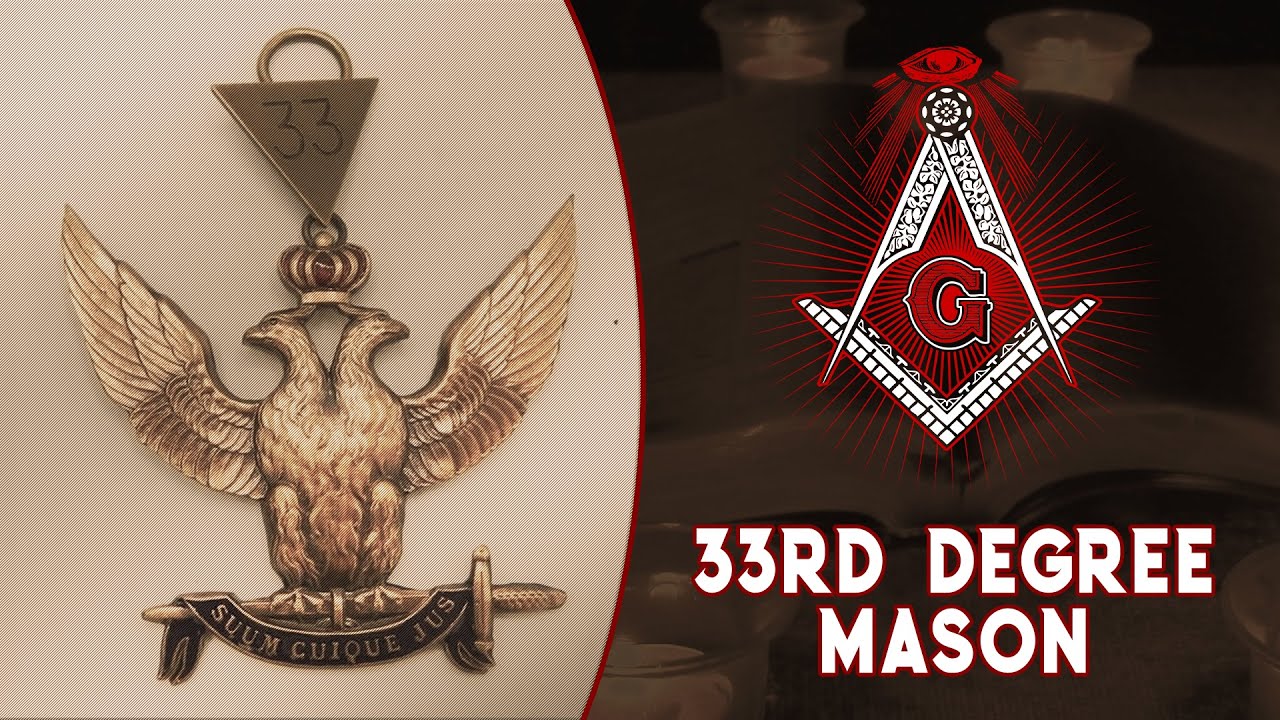
The term “33rd degree Mason” carries an air of mystery, and it is the subject of endless speculation online. In reality, the meaning is both simpler and more admirable than the myths suggest. This guide explains what the 33rd degree actually is, who gives it, how members are chosen, and why it grants no special power.
The Short Answer
A 33rd degree Mason is a member of the Scottish Rite who has been honored by its governing body, called a Supreme Council, for outstanding service. The 33rd degree is honorary. It cannot be applied for or bought, and it does not make the holder the leader of Freemasonry.
Not the Head of Freemasonry
Let us clear up the biggest misconception first. A 33rd degree Mason is not the ruler of Freemasonry, nor a member of a secret inner circle that controls the fraternity or the world. In the structure of Freemasonry, the highest degree any Mason can receive is the third, the degree of Master Mason. Everything after that is additional education offered by optional bodies.
The Scottish Rite is one of those optional bodies. It numbers its degrees from the 4th to the 32nd, and the 33rd sits on top as an honor. A 33rd degree Mason still answers to the rules of his local lodge and his state Grand Lodge, exactly like any other member. The honor confers no governing authority over the wider Masonic world.
Where the 33 Degrees Come From
The 33-degree system took its organized form in 1801, when the first Supreme Council of the Scottish Rite was founded in Charleston, South Carolina. That body, now known as the Supreme Council of the Southern Jurisdiction, calls itself the Mother Supreme Council of the World. A second body, the Northern Masonic Jurisdiction, was organized in 1813.
Today the United States is divided between these two jurisdictions:
The Southern Jurisdiction covers 35 states, the District of Columbia and US territories. Its headquarters is the House of the Temple in Washington, D.C.
The Northern Masonic Jurisdiction covers 15 states in the Northeast and Midwest. Its headquarters is in Lexington, Massachusetts.
Many other countries have their own Supreme Councils, each independent within its territory.
How Someone Becomes a 33rd Degree Mason
The path differs slightly between jurisdictions, but the principle is the same everywhere: the honor is given, never requested.
Step 1: Become a Master Mason
Every Scottish Rite member must first be a Master Mason in a regular lodge. See our guide to the three degrees of Freemasonry for what that involves.
Step 2: Receive the 4th through 32nd degrees
A Master Mason may petition his local Scottish Rite Valley. The degrees from the 4th to the 32nd are usually presented as dramatic plays, often over a weekend or a series of meetings. Any member in good standing can complete them.
Step 3: Years of service
This is where the 33rd degree differs. In the Southern Jurisdiction, a 32nd degree Mason must wait at least 46 months before he can be chosen for the rank of Knight Commander of the Court of Honour (KCCH), an intermediate honor. He must then hold the KCCH for at least another 46 months before he becomes eligible for election to the 33rd degree. Eligibility is not a promise: only a portion of KCCH members are ever elected.
The Northern Masonic Jurisdiction does not use the KCCH. It recognizes service in other ways and elects a limited number of members to the 33rd degree each year.
Step 4: Election and conferral
The Supreme Council itself votes on who receives the honor. In the Southern Jurisdiction this happens at its Biennial Session, held every two years. The degree is then conferred in a special ceremony. Members of the Southern Jurisdiction who receive it hold the title Inspector General Honorary.
Honorary Members and Active Members
There is one more distinction that causes confusion. Most 33rd degree Masons are honorary. A much smaller group are active members of the Supreme Council, the men who actually govern the Rite in their jurisdiction. They are led by an elected Sovereign Grand Commander.
Even this governing group has authority only over the Scottish Rite. It has no authority over Grand Lodges, local lodges, the York Rite, the Shriners or any other Masonic body.
What 33rd Degree Masons Wear
In the Southern Jurisdiction, members are recognized by the color of their caps. A 32nd degree Mason wears a black cap, a KCCH wears a red cap, and a 33rd degree Mason wears a white cap. Many also wear a distinctive 33rd degree ring. These items mark the honor; they do not signal rank over other Masons.
Famous 33rd Degree Masons
Several well-known Americans received the honor. President Harry S. Truman received the 33rd degree in 1945, and President Gerald Ford received it in 1962. Both are covered in our article on US presidents who were Freemasons. Many lesser-known recipients are honored for decades of quiet work in their local Valleys, hospitals and charities.
Why the Myths Persist
Because the number 33 sounds impressive and the honor is relatively rare, it has become a magnet for conspiracy theories. Some claim the number hides a secret meaning, or that 33rd degree Masons run governments. None of this is supported by evidence. The Scottish Rite publishes its structure openly, and its leaders and honorees are listed in its own publications.
The truth is refreshingly ordinary: the 33rd degree is a way for the fraternity to say thank you to members who have served with distinction. For more on separating fact from fiction, see Freemasonry vs. the Illuminati.
Quick Answers
Is the 33rd degree the highest degree in Freemasonry? No. The highest degree of Freemasonry itself is Master Mason (3rd). The 33rd is an honorary degree of the Scottish Rite.
Can you apply for the 33rd degree? No. It cannot be applied for, bought or demanded.
Who awards it? The Supreme Council of each Scottish Rite jurisdiction.
How long does it take? In the Southern Jurisdiction, at least 46 months as a 32nd degree Mason before the KCCH, then at least 46 more months before eligibility for the 33rd.
Does it give power over other Masons? No. It recognizes service and grants no authority over the fraternity at large.
Sources
- Scottish Rite, Southern Jurisdiction (official site)
- Scottish Rite, Northern Masonic Jurisdiction (official site)
- Virginia Scottish Rite: regalia, KCCH and 33rd degree eligibility
Spotted an error? Let us know and we will review it.