The Hidden Masonic Symbols on the Dollar Bill
Is the Eye of Providence on the US dollar really a Masonic symbol? Discover the truth behind the pyramid, the all-seeing eye, and other symbols on America's most familiar currency.
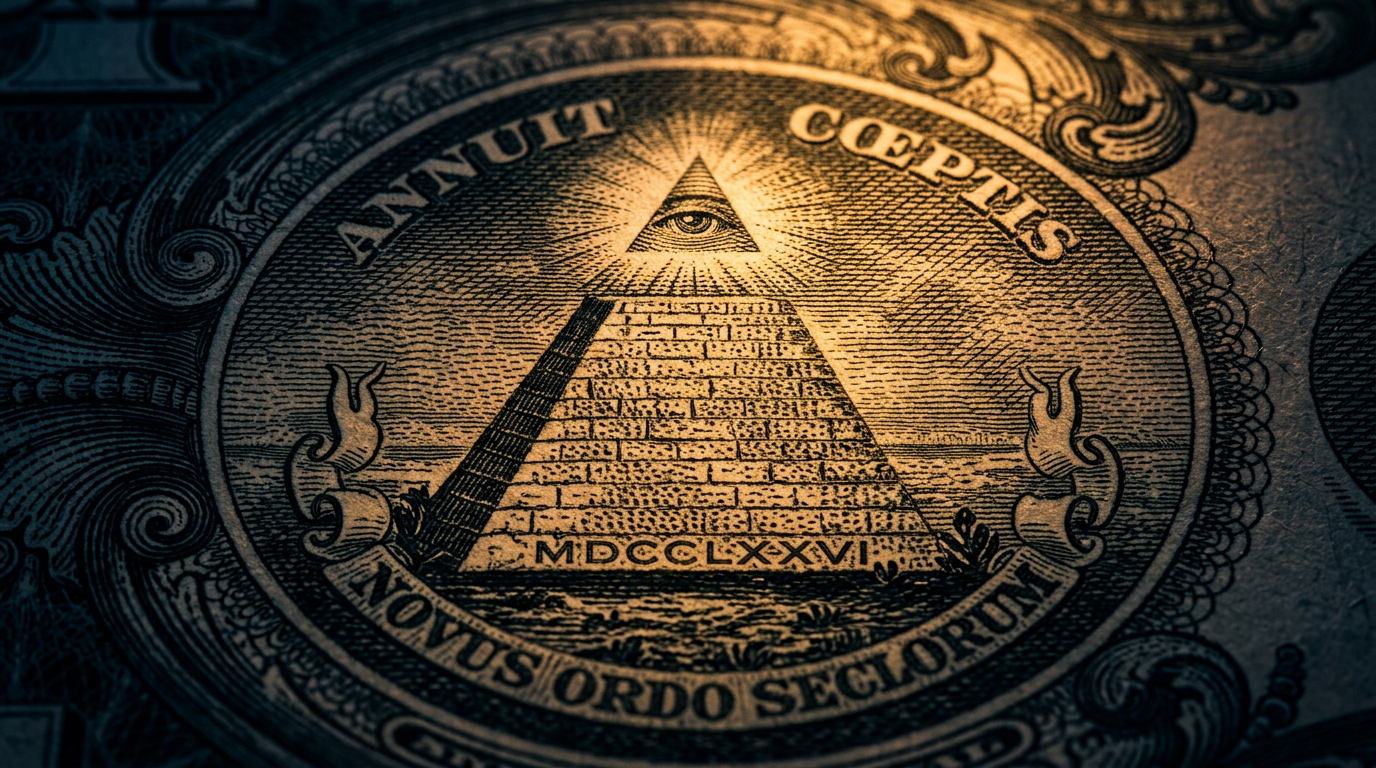
The reverse side of the United States one-dollar bill features two of the most discussed symbols in American history: the unfinished pyramid topped by the Eye of Providence, and the bald eagle bearing a shield. For decades, conspiracy theorists have claimed these symbols prove that Freemasons secretly control the American government. The truth, as always, is more nuanced and far more interesting.
The Great Seal of the United States
The symbols on the dollar bill come from the Great Seal of the United States, which was designed by a series of committees between 1776 and 1782. The final design was largely the work of Charles Thomson, Secretary of the Continental Congress, who was NOT a Freemason. The Eye of Providence was first proposed in 1776 by artist Pierre Eugène du Simitière; the unfinished pyramid came from Francis Hopkinson's 1780 designs, and William Barton and Charles Thomson combined the elements in 1782.
The Eye of Providence
The Eye of Providence — an eye enclosed within a triangle, surrounded by rays of light — was a common Christian symbol long before Freemasonry adopted it. It represented the Holy Trinity and God's watchful care over humanity. The symbol appears in churches and religious art throughout Europe dating back to the Renaissance.
Freemasons did adopt the Eye of Providence as one of their symbols, likely in the late 18th century, after the Great Seal was already designed. So while both use the same symbol, the Seal's use predates its widespread Masonic adoption.
The Unfinished Pyramid
The 13-step pyramid represents the original 13 colonies and the strength and duration of the new nation. It is deliberately unfinished, symbolizing that the work of building America is never complete. The Roman numerals at the base (MDCCLXXVI) spell out 1776, the year of American independence.
The Latin Mottoes
"Annuit Coeptis" ("He [God] has favored our undertakings") and "Novus Ordo Seclorum" ("A new order of the ages") are references to Roman poet Virgil, not to any Masonic tradition. They speak to the revolutionary nature of the American experiment.
The Masonic Connection
While Benjamin Franklin (a prominent Freemason) served on the first committee to design the Great Seal, his suggestions were largely rejected. The final design was primarily the work of non-Masons. However, the overlap in symbolism is not coincidental — both Freemasonry and the Founding Fathers drew from the same well of Enlightenment-era imagery.
The dollar bill didn't feature the Great Seal until 1935, when President Franklin D. Roosevelt — himself a 32° Scottish Rite Freemason — ordered its inclusion. Whether his Masonic membership influenced this decision remains a matter of debate among historians.
The Bottom Line
The symbols on the dollar bill are not Masonic in origin, but they share a common heritage with Masonic symbolism. Both draw from the intellectual and artistic traditions of the Enlightenment, classical antiquity, and Christian iconography. The real story is more fascinating than any conspiracy theory: it's the story of how a young nation crafted its identity from the richest symbolic traditions of Western civilization.